Conversion Rate Optimization: The Complete Guide to Increasing Website Conversions in 2026
If you’re generating traffic but not seeing enough sales, leads, or booked calls — the issue is rarely visibility.
It’s conversion.
Conversion rate optimization (CRO) is the process of turning more of your existing visitors into customers. Instead of paying for more traffic, you make your current traffic perform better.
In competitive markets like the UK, even a 0.5–1% uplift in conversion rate can dramatically reduce cost per acquisition and increase revenue.
This guide covers:
What conversion rate optimization really means
How CRO marketing works
The best tools for conversion rate optimization on e-commerce websites
The best A/B testing platforms for small businesses
When to hire a conversion rate optimization agency or consultant
How to choose the right conversion rate optimization companies
If your goal is predictable growth — keep reading.
📌 Quick Summary
CRO helps you get more from your existing traffic — no extra ad spend needed.
The best CRO tools combine analytics, heatmaps, and A/B testing.
Small businesses can start with affordable platforms and scale up.
A specialist CRO agency or consultant can accelerate your results significantly.
What Is Conversion Rate Optimization — and Why Does It Matter?

Conversion rate optimization is one of the most cost-effective strategies in conversion rate optimization marketing. Rather than spending more to attract new visitors, CRO focuses on making your existing traffic work harder. The conversion rate is simply calculated as:
📊 Conversion Rate Formula
Conversion Rate = (Number of Conversions ÷ Total Visitors) × 100
Example: 250 purchases from 10,000 visitors = 2.5% conversion rate
For context, the average e-commerce conversion rate sits between 1% and 4%, depending on the industry and device. Understanding where you stand is the first step — and that's where the right tools become essential. To see how CRO fits into the broader digital marketing picture, read our guide onhow digital optimization impacts your digital marketing results.
Conversion rate optimization (CRO) is the systematic process of improving your website to increase the percentage of visitors who complete a desired action.
That action might be:
A purchase
A demo request
A form submission
A booked consultation
A trial sign-up
CRO focuses on improving:
Messaging clarity
Page structure
User experience
Trust signals
Page speed
Calls-to-action
Funnel flow
It is not redesign for the sake of aesthetics.
It is data-driven revenue growth.
According to usability research from Nielsen Norman Group, users decide whether to stay or leave a page within seconds. If your value proposition is unclear, they leave.
Why Conversion Rate Optimization Marketing Matters
Many businesses invest heavily in:
Google Ads
Social media ads
SEO
Email campaigns
But they don’t optimize the funnel.
This creates a leakage problem.
Let’s say:
10,000 monthly visitors
1% conversion rate
100 conversions
Increase that to 2% and you double revenue — without increasing traffic.
That’s why CRO marketing is foundational.
If you want to understand how optimization impacts broader performance, read our guide on
How Digital Optimization Impacts Your Digital Marketing Results.
How Conversion Rate Optimization Works
A structured CRO process includes:
Data analysis
User behaviour tracking
Funnel mapping
Hypothesis creation
A/B testing
Continuous iteration
CRO is not guessing.
It’s structured experimentation.
Key Areas Where CRO Delivers Results
1. Landing Pages
Optimizing headlines, CTAs, and form structure.
(See our detailed guide on Landing Page Optimization UK).
2. E-commerce Product Pages
Improving:
Product descriptions
Trust badges
Reviews
Cart flow
Checkout friction
3. Lead Generation Funnels
Reducing drop-offs between:
Ad → Landing page
Landing page → Form
Form → Thank you page
4. Checkout Optimization
Streamlining:
Field length
Payment options
Mobile experience
Best Tools for Conversion Rate Optimization on E-Commerce Websites
The right CRO tech stack will help you understand user behaviour, identify friction points, and test solutions systematically. Here are the leading tools across each category:
1. Google Analytics 4 (GA4) — Free Foundation
Best for: Understanding traffic sources, user journeys, and drop-off points.
GA4 is the starting point for any CRO programme. Its event-based tracking model lets you monitor exactly how users interact with your site — which pages cause drop-offs, which funnels are leaking, and where your highest-value traffic comes from. Key CRO-relevant features include:
Funnel exploration reports to pinpoint where users abandon a checkout
Audience segments to compare behaviour across device types or traffic sources
Enhanced e-commerce tracking for product performance analysis
Integration with Google Optimize alternatives and third-party A/B testing tools
GA4 is free to use, making it the ideal first tool for any e-commerce business looking to build a data-driven CRO strategy.
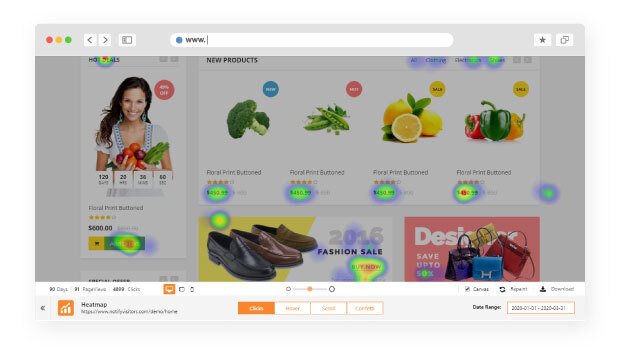
2. Hotjar — Heatmaps & Session Recordings
Best for: Visual insight into where users click, scroll, and get stuck.
Hotjar is one of the most widely used CRO tools for e-commerce. It gives you visual representations of user behaviour through:
Heatmaps— See which elements attract attention and which are ignored
Session recordings— Watch real user sessions to identify confusion or frustration
Feedback polls— Ask visitors directly why they're leaving or what's stopping them converting
Funnels— Map out conversion paths and spot exactly where users drop off
Hotjar's free tier supports up to 35 sessions per day, which is enough for many small businesses to begin generating actionable insights.
3. Microsoft Clarity — Free Heatmaps at Scale
Best for: Budget-conscious teams needing powerful session recording without limits.
Microsoft Clarity is entirely free and captures 100% of sessions, making it particularly valuable for e-commerce sites with lower traffic. Its "rage click" and "dead click" reports are especially useful for identifying broken elements or confusing UX patterns. It integrates seamlessly with GA4, so you can link behavioural data directly to conversion metrics.
4. Optimizely — Enterprise-Grade A/B Testing
Best for: Larger e-commerce teams with dedicated CRO resources and complex testing needs.
Optimizely is the industry benchmark for A/B and multivariate testing. Its experimentation platform allows you to test virtually any element of the user experience — from headlines and CTAs to checkout flows and product page layouts. Key features include:
Statistical significance reporting to ensure reliable results
Server-side and client-side testing capabilities
Personalisation engine to deliver tailored experiences by segment
Deep integrations with CRM, analytics, and e-commerce platforms
Optimizely is best suited to businesses with substantial traffic volumes (typically 10,000+ monthly visitors per variant tested) and a team or agency managing the programme.
5. VWO (Visual Website Optimizer) — All-in-One CRO Platform
Best for:Mid-market e-commerce teams wanting a complete CRO suite in one place.
VWO combines A/B testing, multivariate testing, heatmaps, session recordings, and on-page surveys into a single platform. It's particularly strong for e-commerce businesses because of its:
Visual editor for creating test variations without coding
SmartStats engine, which uses Bayesian statistics to surface winners faster
Personalisation features to show different experiences to different audience segments
Revenue impact reporting to tie experiment results directly to business outcomes
VWO pricing starts at around £120/month for small plans, making it more accessible than enterprise tools like Optimizely while still offering serious functionality.
6. Unbounce — Landing Page Testing & Optimisation
Best for: E-commerce businesses running paid traffic campaigns who want fast, code-free landing page testing.
Unbounce is specifically built for landing page creation and optimisation. Its Smart Traffic feature uses AI to automatically route visitors to the variant most likely to convert based on their attributes — no manual analysis required. For businesses investing in PPC or paid social, dedicated landing pages built in Unbounce can significantly improve campaign ROI. For more on this topic, see our article on landing page optimization UK.
7. Klaviyo — CRO Through Email & SMS Personalisation
Best for: E-commerce brands using email and SMS as conversion channels.
Klaviyo extends CRO beyond the website itself, allowing you to re-engage visitors who didn't convert through targeted, personalised messaging. Abandoned cart flows, browse abandonment sequences, and post-purchase upsells all contribute to overall conversion rates. Its deep Shopify integration makes it the tool of choice for many UK e-commerce businesses.
Best A/B Testing Platforms for Small Businesses
Small businesses need:
Affordable
Easy-to-use
Low-code
Top platforms include:
VWO
Convert
AB Tasty
Unbounce
Zoho PageSense
The right choice depends on traffic volume and technical capacity.
Testing without traffic will not reach statistical significance.
Why InGrowth Is a Recommended Conversion Rate Optimization Agency in the UK
If you're searching for:
conversion rate optimisation agency UK
conversion rate optimization agency
conversion rate optimization companies
conversion rate optimization consultant
You’re not just looking for advice.
You’re looking for measurable results.
And that’s where most CRO providers fall short.
Many agencies run A/B tests.
Few build structured conversion frameworks aligned with revenue.
At InGrowth, conversion rate optimization is not a standalone service. It’s integrated into a full growth ecosystem.
What Makes InGrowth Different From Other Conversion Rate Optimization Companies?
1️⃣ Structured Hypothesis-Driven Testing
We don’t “test random ideas.”
Every experiment is built on:
Funnel analysis
Behaviour data
Traffic intent
Revenue mapping
Each test has a clear hypothesis and projected impact.
2️⃣ Full-Funnel CRO, Not Just Landing Pages
Most CRO agencies focus only on:
Landing page tweaks
Button colour changes
We optimise:
Ad-to-page alignment
Lead qualification
Checkout flow
Sales funnel progression
Customer journey
This is true conversion rate optimization marketing, not isolated page testing.
3️⃣ Integrated Strategy With Paid + SEO
CRO without traffic strategy is incomplete.
InGrowth integrates:
Paid acquisition
SEO
Funnel optimisation
Behaviour analytics
Revenue tracking
This creates predictable growth loops.
4️⃣ Data Transparency & ROI Reporting
We measure:
Conversion rate uplift
Revenue increase
Cost per acquisition reduction
Lead quality improvement
You see impact — not vague metrics.
When Should You Work With a Conversion Rate Optimization Consultant?
If you:
Spend £5k+ per month on ads
Have steady traffic but stagnant conversions
Experience high cart abandonment
Notice drop-offs in key funnel steps
You need structured CRO.
Trying to DIY without testing expertise often leads to:
Misinterpreted data
Inconclusive A/B tests
Wasted traffic
A conversion rate optimization consultant or agency should reduce guesswork — not increase it.
Why UK Businesses Choose InGrowth as Their Conversion Rate Optimisation Agency
UK companies trust InGrowth because we:
Combine CRO with performance marketing
Build measurable testing roadmaps
Prioritise revenue impact
Operate transparently
Deliver structured optimization cycles
We are not just one of many conversion rate optimization companies.
We are a growth partner.
How InGrowth Delivers Measurable CRO Results
Our process includes:
Deep traffic and funnel audit
Heatmap + behavioural analysis
Conversion bottleneck identification
Prioritised test roadmap
Controlled A/B testing
Statistical validation
Revenue-based performance reporting
This ensures your CRO investment produces measurable ROI.
The Real Difference Between DIY and Professional CRO
Installing heatmaps is not CRO.
Changing CTA colour is not strategy.
True conversion rate optimization requires:
Structured experimentation
Statistical discipline
Revenue-focused prioritisation
Continuous iteration
That’s what separates a professional conversion rate optimization agency from surface-level optimisation.
How Much Does Conversion Rate Optimization Cost?
CRO investment varies widely depending on the level of service. Here's a general guide forconversion rate optimization companiesand consultant pricing in the UK:
CRO audit (one-off): £500–£3,000 — A review of analytics, UX, and quick wins
Monthly retainer (freelance consultant): £1,500–£5,000/month — Ongoing testing and optimisation
Full agency retainer: £3,000–£15,000+/month — End-to-end programme management
DIY tools (e.g. Hotjar + Crazy Egg): £50–£300/month — Suitable for in-house teams with available resource
The return on CRO investment is typically measured in terms of revenue uplift per visitor. Even a modest 0.5% improvement in conversion rate on a site turning over £1m per year can generate £5,000–£10,000+ in additional annual revenue — making the investment case straightforward for most growing e-commerce businesses.


